Why Is No One Talking About Nebraska?
Numbers say the Senate race should be a photo finish.
With the 2025 elections in the books, the 2026 midterm races are starting to heat up. Democrats are long shots to take the Senate, but it’s not out of the question if it’s a particularly blue year and strong Democratic candidates score at least two upsets in redder states. As it stands, North Carolina and Maine are Democrats’ obvious targets, with Ohio, Texas, Kansas, Alaska, and Iowa all being reach states, about 10-12 points more Republican than the country as a whole.
But conspicuously absent from most discussions has been Nebraska. Independent Dan Osborn came within 7% of knocking off Republican Deb Fischer back in 2024, and he’s running again, this time against Pete Ricketts.
It seems possible, if not likely, that the national environment will be 6-7% bluer in 2026 than it was in 2024. If Nebraska shifted that much, then Osborn would already essentially be in a tied race. What’s more, Democrats have seen massive gains in special elections held in neighboring Iowa. The Great Plains states, including Nebraska, have suffered from economic volatility as a result of tariffs, and may be primed for a bigger-than-average backlash.
The arguments against Nebraska’s Senate race being close are largely weak. First, the idea that Deb Fischer was a particularly weak candidate is not based on much evidence. Her two prior performances in Senate races before 2024 were not particularly weak, and she was not known as a gaffe-prone or incompetent campaigner. The idea that Fischer is uniquely weak is based entirely on 2024.
Second, Ricketts is not a particularly strong incumbent. Setting aside his 2006 race where he lost in a landslide to Democratic senator Ben Nelson, Ricketts has not put up an impressive electoral record since he began running for office again in 2014. That year, he won the governor’s mansion by 18%, even as Republicans won the Senate race by 33% and Congressional races by a combined 29%. In 2018, he again won by 18%, while Deb Fischer won her own race by 19% and Congressional Republicans won by 27%. Even in 2024, his overperformance was rather mediocre. He outran Donald Trump by 4% against an 82-year-old Democrat who received little outside help and who had never held elected office in the state.
Third, there’s reason to think that Osborn could have more success running against Ricketts than he did against Fischer. Fischer is a lifelong Nebraskan who lives on a ranch in one of the most rural parts of the state. She was elected to the local school board before going to the state legislature, before going to the Senate. Ricketts is the scion of a billionaire family that owns the Chicago Cubs. To the extent Osborn plans to run a populist campaign that frames his opponent as an out-of-touch elite, that playbook likely works better against Ricketts than it does against Fischer.
Osborn’s biggest obstacle is he may just not get the same crossover support he did last time. Voters may see him as more tied to the Democratic Party than they did in 2024, as a truly independent image can be difficult to maintain over the long run. There is some precedent for this. In 2020, Al Gross ran for Senate in Alaska as an independent, but failed to garner any crossover support as voters saw him as a stalking horse for Democrats (see the map below).
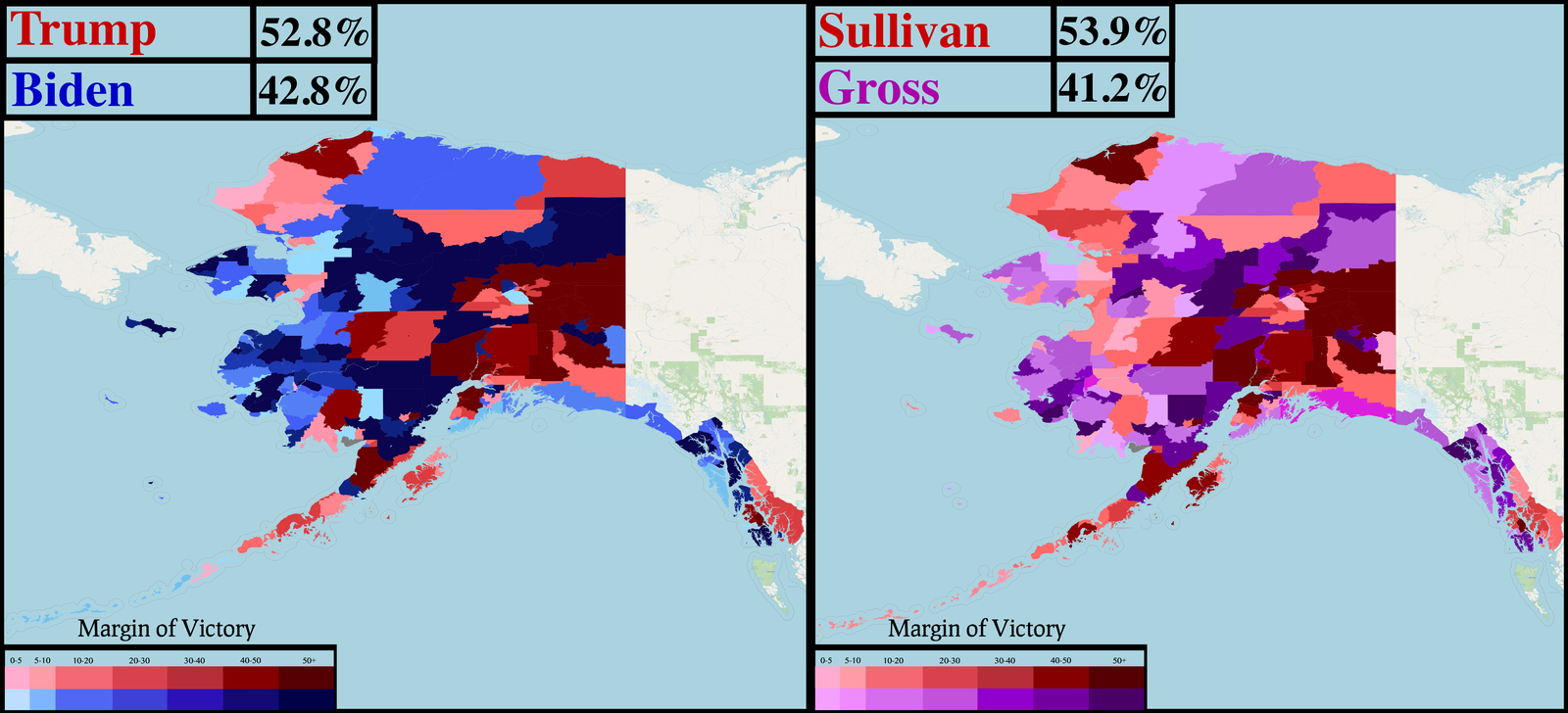
The same fate may await Osborn. Still, the lack of discussion around Nebraska’s race seems to set up Republicans for an unwelcome surprise as the midterms draw closer.
Originally published Nov. 29, 2025 in the FullyReporting newsletter on Substack.